There are two events in history that are forever linked in my mind to Room 509, the room where I taught high school English. Those two events are Columbine and 9/11. I was in the classroom teaching when both these events burst upon the national scene and changed our lives forever.
When such terrible tragedy occurs while one is teaching, the role of being a teacher takes over. I found that I could not allow myself the luxury of fully experiencing my own shock and grief during either event because I had a responsibility to help my students process and understand what was happening without causing them to become even more confused and afraid because of the way I presented myself. I had to be strong for them. I had to reassure them that we were safe. I had to make sure that they knew that I would be in charge of our little corner of the world while I tried to help them make sense of what was happening. I could not give in to panic. I could not cry uncontrollably. I could not go into some sort of stunned shutdown. I had to manage my classroom and look after my students.
I will never forget the morning of 9/11. I was at the front of my classroom standing at my podium taking roll for my first period class when I notice a colleague who did not teach first period standing outside my row of classroom windows that looked out into the library. She seemed terribly upset, shaken. She was the drama teacher afterall, but her distress seemed extreme and quite real. I walked to the door at the back of the room and quietly asked if something was wrong. "Some SOBs have just flown air planes into the Twin Towers in New York City," she said. "Does your television work? Turn it on. We're under attack."
"I can't just go back in there and turn on my t.v. and watch New York being attacked by air," I said. "Find out if this is true and what is really happening. Surely, we will hear from administration if this is true. Surely, they will come and tell us what is happening." "Don't be too sure," she said. "You know how teachers are the last to know."
True. We were the last to find out what was really going on. Within no time at all, parents were showing up at the school and taking their kids home. I had turned the television on by then to try and get some news. I had decided that it was better that the students heard what was going on from a news source in an environment where I had some control. I would be able to help them make sense of what was happening. I asked the students to get out their journals to write about their emotions. I told them to write down their questions that still lingered as to what was really happening. I said it was important to record what they were seeing happen. I encouraged them to write their emotions out. I offered to read and discuss privately what they had written. It seemed to be the only thing I could do that would help the students make sense of a world that had suddenly exploded before their eyes. Perhaps, my approach was wrong. I tried to keep communication open. I tried to reassure. I tried to comfort. I was not ever told how to hand such a thing in any of my teacher ed classes.
I had not taken into account that our principal would finally come on the P.A. with the following announcement: "Teachers, you are to turn off your televisions. You are to follow the lesson plans you have for today. Any news that needs to be relayed to you and your students will come from the office. Do not excuse any student from your classroom unless they are sent for by the office. Do not allow your students to leave your classroom."
He was a former social studies teacher. Somehow, he didn't think it was appropriate that we watch history being made during class time. Somehow, he didn't think the delivery of the curriculum should be adjusted to use the current event topic as a writing prompt. We were to stay on task. There would be no television watching in his school.
Ironically, in my tenth grade English classes we were to read, Contents of a Dead Man's Pockets that day. (Click on the story title to read the story yourself.) The story is about a man who goes after a piece of paper that flies out of a window in a skyscraper. He actually goes out on the ledge of the building to go after the paper.
So, while New York City was under attack, and while the people of New York were facing untold horror, we read about a guy stuck on a ledge of a skyscraper. I don't know when a story seemed more real than the one we read that day. I don't know when a story generated more discussion that seemed to really fit what was going on around us.
It is ironic to me that I now see much on the internet on how teach today's students about 9/11. I am not sure that even now after all these ten years I know that how I handled what I taught my students about what was happening before our very eyes was appropriate. I don't know that I am able to make sense of what happened that day any better today than I could then. I only know that I wanted my students to know that when it appears the world is falling down around you, it is important to pull together, talk to each other, support each other, and to help each other feel less afraid.
We all lost a measure of innocence that day. Life as we knew it changed. The unthinkable had happened. I remembered the bomb drills that we had practiced when I was a child in elementary school during the early 50's when we hid under our desks, or lined up in the hallway with our head tucked between our knees. Those fears of being bombed had been left behind in the 50's. Now, in the first year of the new millennium, I found myself teaching in a classroom while watching air planes attack the center of New York City. I still am not sure any of us can ever teach others what that meant to us personally or to our nation.
Saturday, September 10, 2011


Tuesday, September 6, 2011
Retirement Options?
We didn't have plans for Labor Day, so I suggested to my husband that we wash windows. Finally, at about 11:30 in the morning, we got started on the project. After all, we had our morning routine to follow: drink coffee, read the paper, check e-mail, etc. I had hoped we might not take all morning doing "our morning thing." I didn't say anything to my hubby about needing to step on it so we could get the windows done. After all, I am a smart woman. I wanted his help.
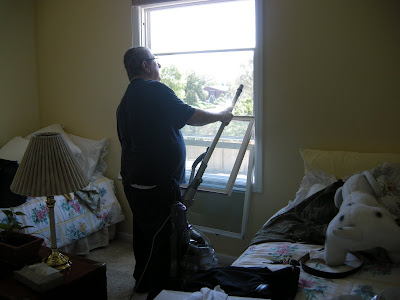
When he finally presented himself to where I had assembled all the window washing equipment, he said, "I was taking this morning as an end of vacation day. Tomorrow I figure I'll go back to retirement."
That's what is so great about retirement; now we have options. Sometimes, I get confused on the difference between a vacation day, and a retirement day, but my husband seems to have figured out that there is a difference.
I felt a little bad asking him to help me work on a vacation day, Labor Day at that. At least he has retirement to look forward during the rest of this week and next before we actually go on vacation.

Cleaning windows is not an easy job. We had to move furniture, vacuum, clean screens, dust out and wash window sills. My helper was no slacker when he got down to business.
By the way, we only got half the windows done. We had to stop because we were so tired, and our backs, hips, shoulders, and wrists were killing us. Hopefully, the bottom half of the house will get clean windows soon.
P.S. Dove, if you read this, we do windows. If you really need us to help you with windows while we are visiting you on vacation, we will.
Sunday, September 4, 2011
Snippets of Summer
Summer Snippets
Fragments of Time Spent Together
Small Treasures Stored
As Precious Memories
Time spent in Colorado with Grandma and Grandpa wouldn't be complete without

sliding down the big rock in Manitou,

trying some Manitou water,

and eating ice cream in Old Colorado City.

These times become very special memories to treasure.
Once everyone gets to Grandma's and Grandpa's house, there is only one thing on our minds:

"Let's go jump!"
Trampoline time with the cousins is always so much fun.

The trampoline is a place to share special conversations, a place where cousins can catch up on things.

A place to perfect new tricks.


The trampoline is where the kids go as soon as they crawl out of bed in the morning.
Bed is a blow-up mattress in the living room.
Three cousins can fit on it sideways.
Hannah opts for the couch.

It is almost a ritual.
Get up.
Walk out to the trampoline.
Once everyone is in place,
grab hands,
and jump.

Good morning, world!
Now let's go make some pancakes.
Mason, master chef, is teaching Gillian how to make pancakes from scratch.
Mason was born just 36 hours before Gillian.

This summer only two siblings were able to be together
at Mom's house.
They spent a few days at their sister Amy's before coming down to Mom's.
Amy had to work, so she missed all the fun,
or maybe she just had some great peace and quiet.

The patio, built by Jon, in Julie's Garden
is designed to be a nice place to rest between jumping times on the trampoline.


This year, the nest on Grandma's front porch is a huge attraction.

The babies hatched just in time so Mama Bird could show them off to the grandchildren.

The two youngest grandchildren,
born a month apart,
received matching bears on their first Christmas.
Guess which one has been half way around the world twice.

Way too soon, the few days we had together were over.
Jonathan, Samantha, and Atticus posed for a family photo before heading back to Boston.

Soon after they left,
Keicha packed up the car so she could drive back to Utah.
Cousin time wasn't quite over yet.
She took Hannah and Mason to Utah with her so they could spend the week with their other cousins in Utah. This year Grandma didn't come along.

My husband has a saying when it comes to visits from the grandchildren.
"The headlights are always wonderful,
but the taillights are even better."

Teary eyed, after hugs all around, with my head full of wonderful memories, I head back to the house towards mountains of laundry! That keeps me busy for a few days.
I then remember something my father always said,
"I'm not wired for kids anymore."
He was right.
The visits are grand.
It is also good to know that my children are now adults with lives of their own to live.
I have snippets of summer caught in wonderful snapshots
to remind me of those precious times we have together.
I'm amazed at how much the grandchildren have grown and grateful that we've all come so far since last year's Bittersweet Summer.
*Many of these beautiful photos were taken by my daughter Keicha. Others were taken by my husband. Thanks for capturing the memories.
*Many of these beautiful photos were taken by my daughter Keicha. Others were taken by my husband. Thanks for capturing the memories.
Wednesday, August 31, 2011
Aging in Place

Mother and I take time for a photograph
as we visited a peach orchard in Grand Junction
2011
This weekend while I was visiting my mother in Grand Junction, Colorado, I learned a new term when I read an article on aging in a special section of the Daily Sentinel. The term "aging in place" is one I had somehow missed reading about, or hearing about, before I read this particular article. "Wow," I think to myself, how did I miss seeing this term before? Since learning this new term, I learned it is the name of an organization and that there is a web site by the same name.
So what does this term mean? According to the home page of aginginplace.com this term means the following: "Aging in place” refers to living where you have lived for years, typically not in a health care environment, using products, services, and conveniences which allow you to remain home as circumstances change. In other words, you continue to live in the home of your choice safely and independently as you get older."
Now, just because I hadn't heard the term, it doesn't mean I was well aware of the concept and its implications to all of us as we get older. My mother is 95 years old and she has been aging in the same place where she currently lives for over 30 years. She and my father moved to the Western Slope of Colorado in the 70's. They loved the place and decided it would be where they would stay even after my father retired. This decision was certainly theirs to make, but the decision has meant that they have never lived near their children and grandchildren. As my parents aged, and after my father passed away, the decision of aging in place has meant that it is a challenge to visit the place where my parents chose to live so many years ago.
My husband and I also live a distance from all our children. While I'm not always happy with this fact, I am mostly happy with where we live. I am not ready or willing to move for a number of reasons.
For the past few years, my daughters in particular have made comments to me such as, "Why do you need this big house? Why do you need this big yard? There are only two of you. You don't need this house anymore. Why don't you move closer to your kids? Why do you have to live so far away?" I find myself feeling a bit entrenched. I feel that I must go on the defensive. "Yes, we need this house. We like to get away from each other. Its big enough to allow this." The rebuttal, "Really. You each need your own office. Why? Neither of you are even working anymore. It is silly that you each have a big office." I dig in my heels. "I'm not giving up my office, and I sure as @#)) am not sharing one with Jim." I realize that I am starting my own argument for "aging in place." I realize that I am having the same discussions with my children that I wanted to have with my parents. I come from the generation where we didn't question our parents decisions quite so much as my children seem to do today.
As I said before, my mother is 95. She doesn't seem that old. She just still seems like my mom. I see my own aging. I see that she is getting shorter and shorter. I see that she takes a cane when she leaves the house, but she is still just as sharp as she ever was. She doesn't miss a thing. She is up on everything. She takes care of her house and cooks her meals. She laughs at a good joke. She even still wear shorts! (And her legs and feet still look pretty darn good She is proud to note that she doesn't have old lady feet.) To me, she seems ageless.
But on the other hand, she has aged. She will age again this coming year. Aging in place means that decisions still must be made so that one has the support need to accomplish this decision well.
I'm still wrestling with what that means for my mother and her wish to stay where she lives, and what that means for my husband and myself as we choose to live where we do as we age. I was deeply moved by a post that Jim Burke had on his blog today. Jim Burke, my guru on how to teach English well, spoke of giving permission today in his blog where he is writing about "senior moments."
We, my children, my mother, and my husband and I are all moving in a continuum of life. We are all in different seasons. We can't make decisions for each other. We must give each other, and ourselves, permission to listen to each other. This keeps us from becoming entrenched, alone, stuck in place.
"We must give ourselves permission to look for and listen to those who know the territory ahead, whose voices can assure us we will make it through to the other side of this season where the days fall like leaves too many to catch. We must give ourselves permission to still listen to ourselves and to live out all those stories we have told but not yet lived." Jim Burke
On this, the last day of August, I am very aware of the seasons and passing from one season to the next.
I recognize that I am moving, have been moving, into the autumn of my life while I watch my mother in the winter of her life. I hope we can learn from each other.
Friday, August 19, 2011
The Narratives of Our Lives
Life changes fast,
Life changes in an instant.
You sit down to dinner and life as you know it ends.
~First words written by Joan Didion after the death of her husband. The year of Magical Thinking
According to Elisabeth Kübler-Ross there are five stages of grief.
In the beginning of my grief journey, I thought I would neatly cycle through these stages. I thought all I had to do was find out what the stages were, read about how to deal with each stage, and then I would just work through the process.
If only grief work were like this. Not long into my journey, I attended a remembrance service at my church. This service, held every November just before the holiday season begins, gave me great solace and put to rest my initial beliefs about the stages of grief. I learned that what I was already experiencing, a cycling through all the stages randomly according to the day was perfectly normal. I learned for many the stages of grief are not accomplished in a linear fashion.
Our culture has a problem with narratives that do not follow a linear format. We expect a story to unfold neatly according to the plot structure that even I once taught in my English classes. We don't like stories that follow a structure we don't understand. I especially like a story that ends neatly at the end with no loose ends dangling, with no questions left unanswered. I don't like surprise endings.
Thus, when I look at the story of my life, and the story of my immediate family, and the story I wish to pass on to my grandchildren about life, and my life in particular, I find that I must deal with a story line I do not like. I wonder how many chapters will be taken up with a narrative I never expected to write, a narrative that I did not want to write, a narrative I wish never to recount because it is so painful.
As I work through the stages of grief, those stages that cycle faster and more dizzyingly through my days than I ever could have imagined, I find I must also observe my children, and my grandchildren, as they rotate through their own cycles and stages of grief. This is doubly painful
As a family, we must continually deal with the loss of a beloved, so very beloved, daughter, sister, aunt, cousin, friend, and we must deal with the knowledge that this loss is result of this dearly treasured person taking her own life.
The second stage of grief is anger. One resource said the following about this stage: "The grieving person may then be furious at the person who inflicted the hurt (even if she's dead), or at the world, for letting it happen. He may be angry with himself for letting the event take place, even if, realistically, nothing could have stopped it."*
As I stood by Julie's body the first time I saw her after her death, I said, "I forgive you." I have since learned that this forgiveness has been an ongoing process. I have raged at her at times. "I gave you life. You had no right to take it." I have asked her, "Do you have any idea what you have done to those who loved you?" Forgiveness does not come easily.
One must work through anger before getting to acceptance according to grief experts. Some days, I am writing a story of forgiveness that takes away the anger, other days, I am not. Mostly, I find I am no longer angry. Mostly, I am finally approaching the telling of story of the aftermath of my daughter's suicide with a theme of understanding for her pain, her confusion, her depression, her illness.
My children each must write their own narratives. Together, we hope to find resolution. We hope to help each other. If our stories of loss and grief help others, than the narrative is not in vain.
My oldest daughter posted a part of her narrative on her blog yesterday. If you wish to read it, you may do so here. She is a beautiful writer. My daughter-in-law commented that it is a "brutally beautiful" post. That it is. But then again, she is dealing with a very brutal narrative.
*Memorial Hospital Website, Towanda, PA
Life changes in an instant.
You sit down to dinner and life as you know it ends.
~First words written by Joan Didion after the death of her husband. The year of Magical Thinking
 |
| Jim's Retirement Dinner Keicha, Jon, Julie, Mom, Amy, Ryan |
According to Elisabeth Kübler-Ross there are five stages of grief.
In the beginning of my grief journey, I thought I would neatly cycle through these stages. I thought all I had to do was find out what the stages were, read about how to deal with each stage, and then I would just work through the process.
If only grief work were like this. Not long into my journey, I attended a remembrance service at my church. This service, held every November just before the holiday season begins, gave me great solace and put to rest my initial beliefs about the stages of grief. I learned that what I was already experiencing, a cycling through all the stages randomly according to the day was perfectly normal. I learned for many the stages of grief are not accomplished in a linear fashion.
Our culture has a problem with narratives that do not follow a linear format. We expect a story to unfold neatly according to the plot structure that even I once taught in my English classes. We don't like stories that follow a structure we don't understand. I especially like a story that ends neatly at the end with no loose ends dangling, with no questions left unanswered. I don't like surprise endings.
Thus, when I look at the story of my life, and the story of my immediate family, and the story I wish to pass on to my grandchildren about life, and my life in particular, I find that I must deal with a story line I do not like. I wonder how many chapters will be taken up with a narrative I never expected to write, a narrative that I did not want to write, a narrative I wish never to recount because it is so painful.
As I work through the stages of grief, those stages that cycle faster and more dizzyingly through my days than I ever could have imagined, I find I must also observe my children, and my grandchildren, as they rotate through their own cycles and stages of grief. This is doubly painful
As a family, we must continually deal with the loss of a beloved, so very beloved, daughter, sister, aunt, cousin, friend, and we must deal with the knowledge that this loss is result of this dearly treasured person taking her own life.
The second stage of grief is anger. One resource said the following about this stage: "The grieving person may then be furious at the person who inflicted the hurt (even if she's dead), or at the world, for letting it happen. He may be angry with himself for letting the event take place, even if, realistically, nothing could have stopped it."*
As I stood by Julie's body the first time I saw her after her death, I said, "I forgive you." I have since learned that this forgiveness has been an ongoing process. I have raged at her at times. "I gave you life. You had no right to take it." I have asked her, "Do you have any idea what you have done to those who loved you?" Forgiveness does not come easily.
One must work through anger before getting to acceptance according to grief experts. Some days, I am writing a story of forgiveness that takes away the anger, other days, I am not. Mostly, I find I am no longer angry. Mostly, I am finally approaching the telling of story of the aftermath of my daughter's suicide with a theme of understanding for her pain, her confusion, her depression, her illness.
My children each must write their own narratives. Together, we hope to find resolution. We hope to help each other. If our stories of loss and grief help others, than the narrative is not in vain.
My oldest daughter posted a part of her narrative on her blog yesterday. If you wish to read it, you may do so here. She is a beautiful writer. My daughter-in-law commented that it is a "brutally beautiful" post. That it is. But then again, she is dealing with a very brutal narrative.
*Memorial Hospital Website, Towanda, PA
Sunday, August 14, 2011
Home Lives On In The Heart

This past weekend, my sister who lives in California was here in Colorado for a visit. She and her husband and my husband and I spent a few wonderful days together. During that time, we drove to Leadville to revisit the place where we once lived.
Our father was transferred to Leadville with the D&RG Railroad to serve as the agent for that location just before I was a senior in high school. My younger sister, shown with me in the photo above, was just starting kindergarten at the time. We were both at different stages in life when we lived there, but we both think of the happy times and wonderful memories made in this special place.

Photo from Colorado History Directory
My father went in and gutted the place before we moved in and brought it up to his standards. It was actually quite nice inside when he finished. The main part of the house was heated with a Stokermatic coal furnace. In other words, it was warm around the furnace, but not so warm the farther away you moved from it. We would actually sit on top of it to get warm. We would also dress in front of it on really cold mornings. The back of the house, an addition that included the kitchen and bathroom, was heated by propane.
Everything is gone now: the house, the depot, the round house. My sister and I walked the property last Friday trying to pinpoint where the house must have been. It is impossible to know for certain. As we walked, I said, "The coal shed must have been here. Look at all the coal." In truth, there was a lot of coal everywhere.
The house now sits in the middle of a lot outside of town serving as a storage shed.


Since the house is gone from its original site, we hope to connect to the place where it once stood.


We walked back to where the round house had been. I really have little memory of this building. Suzanne said she actually got to go in and watch the men work underneath the engine.

We find little to mark the place where we once lived and where our father once worked: just one weathered piece of a railroad tie and a spike. "It's not a golden spike," I say as we look at it. Only an old rusty bucket seemed to have left. I pick it up to bring home. "I might plant flowers in this," I say.

We work our way east on the old railroad yard to the objects that I know are really drawing my sister. Three old abandoned cabooses sit on what remains of a set of tracks. The caboose of the family heads to that magical railroad car that embodies so many of her childhood memories.

When she was in kindergarten, only going to school half a day, when the weather was bad, my father would have her picked up by the railroad crew on its way back to the depot if he couldn't pick her up. Her tiny little figure, dressed in a red coat, the hood pulled up over her head, would climb aboard the caboose and ride home.

Once on the platform of railroad car, she struck a pose. It is hard to see in this photo, but according to her, it was the pose that she saw in all the girlie posters that lined the inside of the caboose.

I soon joined her on the platform at the end of the train. From there, I looked out at the mountains in the distance. Mt. Elbert rose above my former high school and town.


I looked down at the tracks. I was home. I felt connected to my past, my roots, my history. I remember who I am, and where I have been. I am: a railroader's daughter, mountain girl, and a third generation Colorado native. I once lived two miles high. I identify with Molly Brown. It takes a lot to sink me.
Monday, August 8, 2011
The Garden: A Form of Autobiography
If gardening truly is a form of autobiography, then I would have to say that my gardening this year could serve as a metaphor for my life for the past month or so. Mostly, I have felt that I have been living in a hit or miss style when it comes to gardening, blogging, house keeping, and journaling. Perhaps, I have an excuse for this style of living. Perhaps, I do not.
It has been a hectic past four weeks. Family has been visiting. I have many trips up and down I25 from Pueblo to Colorado Springs to visit my son while he was staying at his mother-in-law's house, or to keep doctors' appointments. I have also made my share of trips up and down I25 between Pueblo and Erie, Colorado to babysit grandchildren and help out my daughter Amy in other ways. And, I've even made a trip up North to work on a professional project with which I have been involved over the summer.
I have struggled with anxiety, stress, pain, and grief throughout the summer. I am finally feeling better. I am learning to deal with my stress better. I'm no longer quite as surprised by the waves of grief that continue to wash over me. I am learning to expect this as I move forward in the healing process.
 Most mornings begin with me reading the newspaper, drinking my coffee, eating my breakfast, and chatting with my man while we sit on our back deck. I'm grateful for such an unhurried, peaceful way to start the day. I love the comfort the beauty of my flowers give me.
Today, I did get out of my hit or miss mode and got the roses deadheaded. I also gave the lavender a hair cut since I had neglected to harvest the blooms when they were in their prime. I am hoping for a second blooming.
I keep my old Olympus C740 in the shed to use to record work done on the yard and garden. I also take photos to remind me how a certain bed was planted the year before, or to remind me of lessons I need to learn as I plant in coming years.
Yes, gardening is a form of autobiography.


As in gardening, we must make choices in how we respond to grief.


It has been a hectic past four weeks. Family has been visiting. I have many trips up and down I25 from Pueblo to Colorado Springs to visit my son while he was staying at his mother-in-law's house, or to keep doctors' appointments. I have also made my share of trips up and down I25 between Pueblo and Erie, Colorado to babysit grandchildren and help out my daughter Amy in other ways. And, I've even made a trip up North to work on a professional project with which I have been involved over the summer.
I have struggled with anxiety, stress, pain, and grief throughout the summer. I am finally feeling better. I am learning to deal with my stress better. I'm no longer quite as surprised by the waves of grief that continue to wash over me. I am learning to expect this as I move forward in the healing process.

Today, I did get out of my hit or miss mode and got the roses deadheaded. I also gave the lavender a hair cut since I had neglected to harvest the blooms when they were in their prime. I am hoping for a second blooming.
I keep my old Olympus C740 in the shed to use to record work done on the yard and garden. I also take photos to remind me how a certain bed was planted the year before, or to remind me of lessons I need to learn as I plant in coming years.
Yes, gardening is a form of autobiography.
Autobiographical Lessons from This Year's Garden
- Spacing and planning ahead

I love my zinnia bed in the front yard,
but
I failed to space my planting appropriately.
I have that problem in life.
I had five kids in ten years.
This is another illustration of my spacing problem.
My kids, and my zinnias, are a beautiful sight to behold,
so
maybe a wild, blooming bunch of them all together is not a problem after all.
- Think before you commit to something that might be a hard thing to remove in your life.
I once loved the look of Russian sage that grew in hedges I saw as I drove through town.
I planted three for four of them to use as a hedge in my front yard.
My neighbor put weed killer on all but one of them,
thankfully!
I was so upset with him at the time.
I was so upset with him at the time.
Later, I dealt with the reality of that big, land grabbing, spreading plant that I added to my landscape.
I no longer loved it.
It took two years of applications of weed killer,
an ax,
a shovel,
and a strong man
to get rid of the roots that this plant put down.
Finally, it is gone.
It no longer sends out new plants.
I research things a bit more now before I let them become rooted in my life.
 |
| Digging out Russian sage |
 |
| Using an ax to get the job done |
- Gardening and grief

As in gardening, we must make choices in how we respond to grief.
Grief adds many textures, colors, and dimensions to our lives that were not there before.
We have a choice on how we respond to grief.

In the early days of the grief experience, we sometimes think our lives will never bloom again.

During a time of mourning and grief, everyone turns to something.
Making choices that mask our pain is done because we believe this will make our pain go away.
In reality, such choices can delay our healing.

H. Norman Wright said that after the loss of a loved one
it takes at least eighteen months
it takes at least eighteen months
to experience longer stretches of time with less pain.

By trusting God's healing grace,
I find I am moving forward
in life
and
in healing.
Grief changes everyone.
Grief is hard work.
Doing the hard work of grief brings the lessons that only grief can teach us.

When we invite grief to changes us,
it deepens us.
It grows our souls.

We find peace.
* Many of the lessons on grief quoted in this post were taken from Susan Duke's book, Grieving Forward, Embracing Life Beyond Grief.
** All of the flower photos were taken today in my garden.
- The pink rose bud: Queen Elizabeth
- The white rose: Pope John Paul II
- The red rose: I did not record the name for this rose. I named it Julie many years ago.
- The pink/yellow rose: The Peace Rose
Subscribe to:
Posts (Atom)